Structure and Components of the Bhitti Yantra
भित्ति यन्त्र — वेध शाला उज्जैन

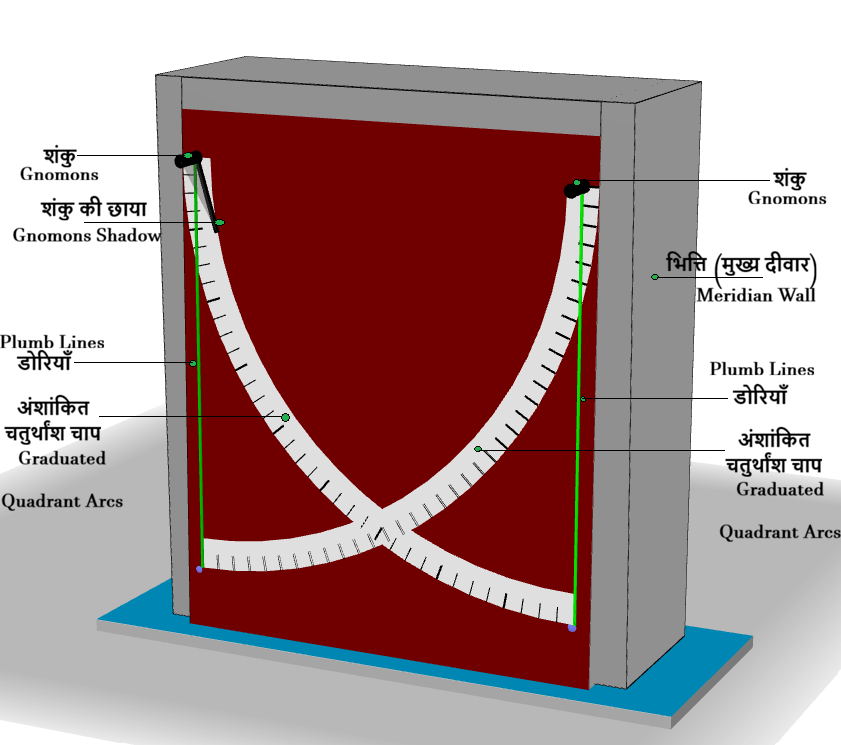
The Bhitti Yantra consists of a large, rigid vertical wall precisely aligned with the north–south meridian plane. Both of its faces (the east-facing and west-facing surfaces) are used for astronomical observations. The instrument is designed according to precise geometrical and astronomical principles, enabling highly accurate measurements of the positions of the Sun, planets, and stars.

Main Components of the Bhitti Yantra

  • Meridian Wall: The principal component of the Bhitti Yantra is a large, flat wall erected exactly in the meridian plane. Its surface is vertical, i.e., perpendicular to the local horizontal plane, and serves as the fundamental reference plane for astronomical observations and measurements.
  • Gnomons: Two gnomons are mounted at the upper corners of the meridian wall, projecting perpendicular to its surface. These form the essential observing elements of the instrument. During the forenoon and afternoon, their shadows fall on the wall and are used to determine the positions and motions of celestial objects.
  • Graduated Quadrant Arcs: Two graduated quadrant arcs are constructed using the two gnomons as their respective centers, each having a radius equal to the distance between the gnomons. The arcs are finely graduated for precise angular measurements and intersect at a common point. When the observed celestial object lies south of the Prime Vertical Plane passing through this point, observations are made using the southern gnomon and its corresponding quadrant arc. Conversely, when the object lies to the north of the Prime Vertical Plane, the northern gnomon and its quadrant arc are used.
  • Plumb Lines: A plumb line is suspended from each gnomon, with a length slightly greater than the radius of the corresponding quadrant arc. These lines are used to align the shadow of the gnomon or the observed celestial object, thereby improving the accuracy of astronomical observations and measurements.

Since the meridian wall is aligned precisely along the north–south direction, both its eastern and western faces can be used for observations at different times of the day. At Local Solar Noon, when the Sun crosses the local meridian, the shadow of the gnomon falls at a definite point on the graduated quadrant. From this position, the Sun's meridian altitude, declination, and the instant of Local Solar Noon can be determined.

The Bhitti Yantra at the Ujjain Observatory is constructed of stone and carries finely engraved angular graduations on its east-facing surface. It has been scientifically designed for the latitude of Ujjain (approximately 23.18° N), enabling highly precise astronomical observations and measurements.
Working Principle

To understand the working principle of the Bhitti Yantra, it is essential to be familiar with a few fundamental astronomical concepts and definitions. The primary purpose of this instrument is to accurately measure the zenith distance of a celestial body at the instant of its meridian transit. Once the zenith distance is measured, the celestial body's declination, altitude, and other important astronomical coordinates can be determined using the known latitude of the observation site.

Fundamental Astronomical Definitions

Zenith: The zenith is the imaginary point on the celestial sphere located directly above the observer.

Zenith Distance (Z): Zenith distance is the angular distance of a celestial body from the zenith, measured along the observer's meridian. Its value ranges from at the zenith to 90° at the horizon.

Altitude (h): Altitude is the angular elevation of a celestial body above the local horizon. It is complementary to the zenith distance and is given by

Altitude (h) = 90° − Zenith Distance (Z)

Declination (δ): Declination is the angular distance of a celestial body north or south of the celestial equator. It is one of the two principal coordinates of the equatorial coordinate system. For example, the Sun's declination varies throughout the year between approximately +23.5° and −23.5°.

Latitude (φ): Latitude is the angular distance of an observation site north or south of the Earth's equator. It specifies the geographical position of the observer and plays a fundamental role in relating terrestrial and celestial coordinate systems.

Working Principle

भित्ति यन्त्र — वेध शाला उज्जैन

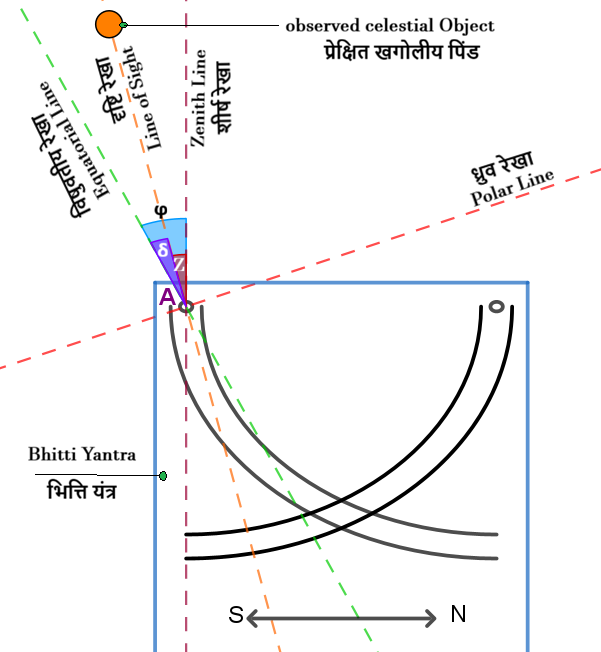
Consider one of the gnomons of the Bhitti Yantra, located at point A, as shown in the figure. Let us define a set of reference lines lying in the meridian plane, all intersecting at point A.

Reference Lines

  • Polar Line: A line passing through point A and parallel to the Earth's axis of rotation. This line points toward the celestial pole and therefore indicates the direction of Polaris.
  • Equatorial Line: A line passing through point A and parallel to the Earth's equatorial plane.

Now, consider two additional lines in the same meridian plane:

  • Line of Sight: A line passing through point A and the observed celestial body.
  • Zenith Line: A line passing through point A and the zenith (the point directly overhead).

Geometrical Relationships

From the geometry of these lines, the following angular relationships can be established:

  • The angle between the Equatorial Line and the Zenith Line is equal to the latitude of the observation site, denoted by φ.
  • The angle between the Line of Sight and the Equatorial Line gives the declination (δ) of the observed celestial body.
  • The angle between the Line of Sight and the Zenith Line gives the zenith distance, denoted by Z.

In the Bhitti Yantra, the observer aligns the plumb line with the line of sight toward the celestial object. This alignment enables direct measurement of the zenith distance (Z). Once Z is measured, other celestial parameters, such as the declination, can be determined using the geometric relationships among these angles.

Meridian Relation

For a celestial body lying on the meridian, the zenith distance is given by:

Z = |δ − φ|

where:

  • Z = Zenith distance
  • δ = Declination of the celestial body
  • φ = Latitude of the observation site

Thus, the Bhitti Yantra functions as a precise astronomical instrument for determining celestial coordinates through geometric measurements in the meridian plane.

How to Perform Observations Using the Actual Instrument

Procedure for Astronomical Measurements Using the Bhitti Yantra

  1. Begin the observation at the instant when the selected celestial body crosses the local meridian (Meridian Transit), since the Bhitti Yantra is designed to make measurements at this moment.
  2. Determine whether the celestial body lies south or north of the Prime Vertical Plane. If the body is in the southern sky, use the southern gnomon and its corresponding quadrant arc. If it is in the northern sky, use the northern gnomon and its corresponding quadrant arc.
  3. Adjust the sighting cord (plumb line) attached to the selected gnomon along the quadrant arc until, when viewed along the cord, the gnomon and the observed celestial body appear perfectly aligned in a single straight line.
  4. The point at which the sighting cord intersects the quadrant scale gives the Apparent Zenith Distance of the celestial body.
  5. Apply the necessary corrections, including atmospheric refraction and any instrument-specific calibration, to obtain the True Zenith Distance. In the case of the Bhitti Yantra, if a fixed correction of 10° is prescribed, the true zenith distance is obtained by subtracting 10° from the measured apparent zenith distance.

The Bhitti Yantra Simulation

Follow the steps below to observe and operate the Bhitti Yantra Simulation:

  1. Click the Reset button to restore the simulation to its initial state.
  2. Enter the Latitude and Longitude of the observation site, and then click the Enter button.
  3. Use the Date slider to select any day of the year. Observe the position of the gnomon's shadow on the wall at local noon for the selected date.
  4. Adjust the Time slider until the shadow of the gnomon reaches its maximum length on the wall. This instant corresponds to the Sun's Meridian Transit.
  5. Determine whether the shadow of the gnomon is inclined toward the north or the south.
  6. If the shadow is inclined toward the north, drag the control point at the end of the green sighting cord attached to the southern gnomon along the quadrant arc until the cord coincides exactly with the gnomon's shadow.
  7. If the shadow is inclined toward the south, drag the control point at the end of the green sighting cord attached to the northern gnomon along the quadrant arc until the cord coincides exactly with the gnomon's shadow.
  8. Once the sighting cord is perfectly aligned with the shadow, note the value displayed as North Quadrant Reading or South Quadrant Reading on the right-hand side of the simulation.
  9. The reading obtained from the quadrant arc represents the Apparent Zenith Distance of the Sun for the selected date.

Location-Specific Bhitti Yantra Calibration Template

Calibration of the Bhitti Yantra Quadrant Arc

This tool enables you to generate a location-specific calibration template for the quadrant arc of the Bhitti Yantra. The template is customized according to the geographical coordinates of your observation site and can be used to construct a functional wall-mounted Bhitti Yantra.

Click the Print button in the simulation below to download the calibrated quadrant arc as an image. Print the image at the desired scale according to the dimensions of your Bhitti Yantra model. Carefully attach the printed template to the east-facing wall surface of the instrument, ensuring that the marked North–South direction is correctly aligned.

Install two gnomons at the centers of the circles indicated at the top of the printed template. Then tie a string slightly longer than the distance between the two gnomons to their upper ends. This string serves as the movable sighting cord for astronomical observations.

Mount the completed Bhitti Yantra model in an open area with its wall accurately aligned in the Meridian Plane. By following the procedure described in the Working Procedure section, you can calibrate the quadrant arc for your location and construct a fully functional Bhitti Yantra suitable for astronomical observations.